Leadership • Language • Justice • Purpose

Haitian Creole Legal Language Specialist, storyteller, and community builder helping you communicate clearly, lead confidently, and create meaningful impact.

Tag: leadership

  • Leadership, philosophy, clear thinking, and living a good life with simplicity

    Philosophy professor Marietta McCarty, and New York Times bestselling author questions one of her college students about “what is a good life”.
    “Good living means having the time to actually think…”, said the student as reported by Marietta McCarty in her book “how philosophy can change your life, 10 ideas that matter most”.
    Good living is about investing time to produce ideas which are the building blocks of our lives.  Thinking produces ideas which help us to find our way and know what really matters.
    marietta1Clear thinking is a lasting benefit of quiet introspection, solitude, and good conversation which cultivate our sense of wonder.
    The first idea developed in this book turns around the concept of “Simplicity.”
    McCarty gives us food for thoughts about simplicity. She develops this topic based on ideas of ancient philosopher Epicurus, and modern thinker Charlotte Joko Beck.
    Epicurus, 341 BCE, a citizen of Athens, decided to lead a private life for his tranquility. He decided that public life and politics in particular made tranquility impossible.
    Charlotte Joko Beck is an American pianist who delved into the study of Zen Buddhism after assuming the responsibilities of a single mother of 4 children.
    With the conceptual framework. and the ideas of these thinkers, McCarty invites us to reflect and hold conversations on simplicity, prudence, needs, wants, independence, and freedom from our own ego and self-concern.
    Charlotte Joko Beck calls life “a very simple matter”. What is simplicity? What is a simple way of living? It is as simple as having the basics that we must have for good living.
    We need to leave behind complicated lives to “savor a life spent enjoying the simple pleasures which feed our essential selves.
    Our first priority is to be a mental and spiritual well-being. We do not need much to satisfy our material needs. We overlook “ordinary” joys when we overextend our reach into the world of things. We are moving fast to acquire things and lifestyle. Debt conquers our peace of mind. We become “multitasker”. We are not in the center of our lives. Our energy is scattered and depleted. Epicurus
    We are racing to nowhere. This prevents us to think and produce ideas. Clear thinking is impossible if material concerns remain our priority and our goals.
    This endless race of materialism and acquiring stuff is a dead end of anxiety and sadness.
    Simplicity is a prerequisite for thinking clearly. It clears the mind as a dust cloth, and as the mind brightens, clear thinking is possible, and the fountain of ideas and simple pleasures is open.
    Charlotte Joko Beck agrees with Epicurus on living a life’s simple pleasures.
    “Go slow to go fast”, said Best-selling author Chris Brady in his acclaimed book “One month in Italy and Rediscover the art of Vacation.”
    Epicurus in his “Letter to Menoecus” said “Pleasure is the end…. Freedom from pain in the body and trouble in the mind.”
    His philosophy evolved from his life experience: pleasure is the main ingredient of a good life and simplicity is the key to obtaining pleasure and minimizing pain.
    Extravagance has consequences, he said inviting us to discover the freedom that comes from needing little.
    Prudence vs Desire
    Epicurus is known for his accent on pleasure as the aim of life. But, in my studies of his philosophy as mentioned by McCarty, his central virtue is prudence. This requires a rigorous examination of the circumstances of our lives.
    While pleasure is the goal of life, we must be very smart in how we go about achieving it. Desire is a powerful fuel. Prudence can keep desire in check with its sensible detection of the true needs in our lives.
    Epicurus made a critical distinction between needs and wants. Some desires are natural, other desires are vain, he said.
    We have the power of discernment and we can figure out what is essential for a pleasurable life and what is not.
    Just as Epicurus departed from public life in Athens, Professor McCarty invites us to shift- not necessarily physically, but surely mentally and spiritually- away from the roar of mainstream culture’s advertising and media glitz.”charlotte

    Bestselling author Orrin Woodward invites us to “escape the financial matrix” which is a web of debt which brings control and profit for the elite, stress, debt,  and anxiety for the masses.
    Epicurus is optimistic. His idea is we have the ability to deal with mental disturbance using our reasoning power to adjust our lives accordingly. He elevates mental pleasures over physical pleasures. Mental pleasures are more numerous; more easily controlled, and rarely have painful consequences.
    We can temper our desire by disciplining ourselves to need less.

    Beck said desire causes suffering. We have to let go our ego by avoiding to manipulate life to suit our expectations. We need to be our own measure of success, and grow confident that an unadorned life is also full of pleasure and lasting satisfaction.

    philosophyPhilosophy is the act of asking question. I invite you to reap the rewards of hearts and minds by reflecting, and sharing your personal experiences on the following questions.

    -What are some of your life’s simple pleasures? Why do you forget them?

    – Do you confuse what you need and what you want?

    – Describe what you need for a satisfying life? Are you surprised  at the things that you do not include?

    -Are you “too busy”?

    – When was the last time you just sit and do nothing?

    If you have a good appetite for food for thought, I invite you to read Marietta MacCatty’s book “How Philosophy can save your life, 10 ideas that matter most”.

    Roosevelt Jean-Francois

  • Tennis Player Victoria Duval is back on the court and shared a life leadership lesson about her dreams, struggle, victory

    vicduv4I just read that story penned by tennis player Victoria Duval announcing her return to the court after being diagnosed with Hodgkin’s lymphoma. I was happy to hear she is now cancer free after she underwent chemotherapy and treatment. I feel inspired by her story. I know her parents. I went to the same school with his father. Her mother and father are both medical doctors who went through deep challenges to raise their 2 sons and their 19 year old daughter Victoria Duval.


    Victoria is a great story of Dreams, Struggle, Victory. She was 7, when she dreamed of  playing tennis and conquerred the world one set and tie break at a time.

    Her struggle started when she was robbed at gunpoint and held hostage in Port-au-Prince, Haiti, where she grew up. Her father had his legs broken, his left arm crushed, his ribs fractured ribs, after he stayed 11 hours under the earthquake destroyed his in January 2010 in Haiti. vicduval7

    She was 17 when she made her first professional appearance at the US Open in 2013. Then in 2014, she was in Wimbledon before she was diagnosed with Hodgkin’s lymphoma.

    Today, she is claiming her victory to life. She is cancer free, she is writing her memoir, and she just wrote this story for the online magazine The players Tribune,

    I hope you find the same joy, passion, and inspiration I had when I read this story that I share with you below.vicduv3

    My prayers are with the Duval’s family for their dreams, struggle, victory.

    God bless,

    Roosevelt

    June of 2014, at the age of 18, I was competing in a tournament in Mexico when I felt a large lump in my neck. I was traveling with a coach at the time. I didn’t think anything of it but informed my mother immediately.

    Just to be safe I did some scans when I got home and they told me that everything seemed to be okay. My mother and I traveled to Europe a few days later. I was extremely excited to go to Wimbledon — I’d only played the junior event, never the women’s. My ranking wasn’t high enough to get into the main draw, but I had made it to the qualifying rounds. Three wins, and I was in.

    A few weeks into the trip, the lump kept getting bigger and bigger. My mom, relying on her medical background, had a hunch that something was very wrong based on its location. The tournament doctor, agreeing with my mother’s intuition, quickly arranged for an emergency biopsy.

    The day before my first round of qualifying, I was told that the results came in. That was probably one of the most stressful moments of my life. My legs were shaking as I made my way over to the doctor’s office. I didn’t really know what to think, to be honest, but nothing could have prepared me for the news I was about to hear.

    She said I had cancer.

    As soon as she said that, I immediately blacked out and cried hysterically. I didn’t know much about cancer — I just automatically associated it with death. This may sound dramatic, but I even started thinking about how I wanted to spend my last moments on Earth.

    The physical therapist who had accompanied me to the office told me that if I wanted to go home I could. But going home was the last thing I wanted to do. I came to England with one goal— to get through qualifying and play in the main draw at Wimbledon. And I made a decision that I wasn’t going to let this diagnosis stop me.

    vic-duv

    The physical therapist advised me to keep the news as private as possible, and to stay focused on the tournament. For better or worse, my state of denial made focusing quite simple. I went on to win all three of my qualifying matches — and, in the first round of the main draw, even beat a girl ranked Top 30 in the world.

    I didn’t know much about cancer— I just automatically associated it with death.

    Once my illness was more thoroughly explained to me, I realized that I had a great chance of winning the battle with cancer. My fears started to slowly dissipate. And in the same way that I relied on my faith to get me through qualifying, I knew that God had a plan for me in this new battle.

    When I flew home, I went to the hospital to do some more tests and build a plan of treatment. Hearing the effects and process of chemotherapy terrified me. Nonetheless, I was optimistic.

    That optimism was short lived. A few days later, after finishing my first round of chemo, I lost hope. I didn’t see how I was going to be able to deal with feeling so horrible for three months. But I somehow found the strength to persist.

    Every two weeks, my parents drove me to Jacksonville for treatment. Words can’t really express what it feels like to go through chemotherapy. The constant urge to throw up, headaches, stomach pains, fatigue, loss of appetite, metal taste in your mouth, and the list continues. The good news for me was that I was in stellar shape before starting treatment, so my body responded well. I was even able to play some tennis.

    fter completing my last round of treatment in September, I cried enough tears to fill a lake. Tears of joy, of course. Three months felt like an eternity, but I did it! I won my battle with cancer!

    My oncologist informed me that the fight wasn’t over, however. He said the road to recovery would be a long and arduous one. I thought, well, how bad could this be? The tough stuff is over now! Not so fast…

    I started playing tennis again in late November. I was ecstatic to be back on court. Even though my body didn’t last long at practice, it surely felt like a privilege. In December, I started doing a lot of pool workouts with my physical therapist to start building some strength. The first month was very difficult. My muscles had practically atrophied. At the time, it seemed impossible to get back in shape. But I kept pushing. After a few months, I became strong enough to graduate from physical therapy to tougher fitness training with a conditioning coach. In March, my trainer and I felt that it was time to really focus on the gym. From a tennis perspective, my timing was there. But physically, I couldn’t keep up on the court.

    I started to feel much better around April — though still not even at 50 percent of where I was before treatment. For the past two months, it has been steady progress: 30 minutes in the gym, turning to an hour, then turning to an hour and a half. At this rate, I’m going to be back to doing what I love in no time!

    My goal is to be playing tournaments in a few weeks. I am also writing my memoir, coming out Fall 2016, in which I will elaborate in much more detail about my journey.

    This journey has been a tough but educational one. The most important lesson I learned is appreciation. I learned that good health is a privilege — and that, once you have something taken away from you, you begin to realize how much you took it for granted.

    Finally, I learned that everything happens for a reason. God has opened my eyes to a new meaning of life, and showered me with many blessings. Little did I know how much of a blessing this illness would end up being.

    I wouldn’t change what I went through for the world.

  • Setting People Free at the Life Leadership Summer Leadership Convention this week-end in Green Bay, Wisconsin

    I spent this week-end at the Life Leadership Summer Convention with my three kids, a lot of friends, and thousands and thousands of members of the Life Leadership Compensated Community in Green Bay, Wisconsin. We had fun, we learned, and we got inspired,uplifted, and renewed with passionate vigor and lasting motivational speeches and, meaningful conversations with top leaders and achievers in the Life Leadership Compensated Community.

    IMG_3673I flew from Fort-Lauderdale to O’hare, Chicago, and drove to Green Bay, WI. As a Green Bay fan, I was anxious to discover the Lambeau Stadium, home of the Green bay Packers and the legendary football coach Vince Lombardi for whom “winning is everything”.

    Bestselling author, and CEO of Life Leadership, Chris Brady kicked off the even with these simple words: “We set people free”.

    IMG_3620LIFE Leadership is dedicated to providing solid world-class training to any individual ready to commit to a lifestyle full of challenges and success”, he told a very enthusiastic audience.

    Life Leadership has delivered what it said we can expect from a leadership convention. This is a place to learn the newest, most stimulating and insightful information, and to bond with our community on a much deeper level

    Always a blast, the Leadership Conventions offer an unforgettable weekend full of training, inspiration, cheering, and fun. Top LIFE industry leaders share personal insights and life-changing information that will help us catapult our leadership development and self education business and life to new heights.

    There was never a dull moment at this Leadership Convention. I jumped on my feet with excitement and shouting with enthusiasm.

    IMG_3690The speakers were outstanding covering every aspect of building and developing the LIFE business while teaching principles of leadership and personal development.

    Haitians find Hope through Life Leadership.

    I was so delighted to see how many Haitians who came from Haiti to participate in this event. They were  proud to carry the blue and red flag to cross the Convention stage as they were being recognized for their achievements for the last quarter.

    Haitian Leader Thierry Laplanche, who won the top gun power player contest, the higher quarterly most disputed contest in the Life Leadership Community, shared his dream that ‘one day, the Haitian flag will be on the podium by the US, and Canadian flags”.

    “This will be a symbol of Haiti being on its way to prosperity, wealth, and peace, and a symbol that Life Leadership can change the world”, said Laplanche, a medical doctor, turned to be a leadership expert and the one of the top community builders in Haiti at the moment.IMG_3681

    Whether you are just starting out or are a seasoned professional, Leadership Conventions will inspire, motivate, and compel you to keep moving forward.

    IMG_3670

    IMG_3641

  • Leadership development, spiritual retreat, and listening to father Dumarsais Pierre-Louis teaching about Jesuit Karl Rahner’s foundations of faith.

    A very tall big man got in the retreat meeting room. He sat quietly in front of us.

    Monsignor Chanel Jeanty introduced him as father Dumarsais Pierre-Louis, the spiritual director of the retreat. Father Dumarsais is from Gonaives, Haiti, and is on a sabbatical year from the West Palm Beach diocese, where he normally works as a catholic school spiritual counsellor.

    He moved to the lectern, stood up straight, and closed his eyes, inviting the holy spirit to be with us at this special moment.

    Father Dumarsais asked Monsignor Chanel his permission to make a slight correction. Monsignor nodded “yes”, and Father Dumarsais cleared his throat to say:

    “I am not the director of the retreat. I may me the facilitator.  God is our director, He will lead the retreat.”karl rahner2

    Here are some notes I jot down from father Dumarsais’s introduction of the retreat:

    “ God will take us as far as He has been. We need an active faith to follow Him in good and bad moments. Our faith is always being tested.”

    “This is Saepe expertus which means we are always tested by our doubts, sins, twits, and turns in life.”

    “We have to forgive. Forgiveness is liberation. It’s a gift we give to ourselves.”

    “Eternal life is the biggest bank we can invest in.”

    “The church is also the church of the sinners. The church is not a museum of saints, but a hospital for the sinners, for those who are carrying the weight of life.”

    Father Dumarsais introduced us to the teaching of Karl Rahner, a German Jesuit priest and theologian who is considered one of the most influential Catholic theologians of the 20th century. Rahner’s theology influenced the Second Vatican Council and was ground-breaking for the development of what is generally seen as the modern understanding of catholicism.

    Father Dumarsais shared 5 attitudes from Rahner’s foundations of faith:

    karl rahner1.-  Total belief. Give up yourself to God.

    2.- Be mystic. Live every day in mystery with the grace of God. Live a reality which is not real.

    3.- Silence. Create space for silence. Eliminate noise to embrace silence. Pray.

    4.- Love your neighbor as you love God.

    5.- Be positive. Take responsibility.

    He sent us to sleep asking us to meditate and to create internal dialogues on the two following questions:

    1.- What part of my life does not reflect God’s message of hope?

    2.- What part of my life should I give total control to God?

    Have fun. God bless,

    Roosevelt

  • Leadership and Philosophy

    I posted yesterday New York Times bestselling author Orrin Woodward’s observations on the gap between  our intentions and our actions which creates our limiting beliefs. This morning, I reflect on the gap between life and knowledge which is growing wider and wider.  Only by asking the right questions,  can we close this gap and live the life we’ve always wanted.

    The questions we ask ourselves lead to the stories we tell about ourselves. Leadership and philosophy start with simple questions about life, death, and the pursuit of happiness.

    Pythagoras and other pre-socratics, Socrates, Plato, Aristotle, and other modern great thinkers such as voltaire, Lao Tsu, Dewey, Santayana, Thoreau, Firmin etc … have grappled with enduring basic questions which have preoccupied humanity from the beginning.

    Who am I?

    Where did I come from?

    What is the best way to live?

    What am I here for?

    What’s the best way to organize society?

    ¨The more people who ask this question and rigorously pursue an answer to it, the more dynamic and vibrant a society will be¨, said Mathew Kelly, a New York Times bestselling author of the Rhythm of Life.

    Philosophy which Plato called  ¨that dear delight¨ includes five fields of study: logic, esthetics, ethics, politics, and metaphysics, acceding to Dr. Will Durant in the Story of Philosophy.

    Logic deals with thought and research, esthetics with form and beauty, ethics with conduct, politics with social organization, and metaphysics with ultimate reality. (Will Durant)

    People create ideas and attitudes which become culture and expressed as philosophy of life. We each have our own philosophy, our personal perception, and rule of life. We have our set of beliefs by which we chose to live.

    You do have a personal philosophy. It affects what you eat, what you wear, the way you consume information, and the direction you lead your life.

    Communities also have philosophies. These philosophies are the sum of philosophies of its members. These communities can be as small as a family or as large as a nation.

    This is by the flow of questions and the conversations that these communities entertain that they can move from being victims to leaders who take into their own hands their life and their pursuit of happiness.

  • A leadership conversation with Speaker, Life Coach, Rachelle Sylvain Spence in Weston, FL.

    I spent this Friday morning asking questions, listening, talking with my new friend Rachelle Sylvain Spence, in Weston, Florida. We spoke for two hours about her leadership skills, life issues, vision, mission, and speaking ability. I left her deeply impressed by her inner purpose to touch and impact other people’s lives.

    It was fun. Rachelle is so unique. She spoke with clarity and vividness with direct eye contact and a bright smiling face. Her life journey is so fulfilled, and she express it with joy.  rachelle-s-1

    I ate slowly my bowl of soup, and sipped my water, and asked questions. Her story took us to New York (Queens, Long Island, Brooklyn), Haiti (Port-au-Prince, College Bird) Philadelphia, Florida.

    She was born in New York from Haitian descent parents. The family moved to Haiti with her where she started school. Then, she got back to the US at 16 ending high school. She went  to college starting with Economics, then changing to Sociology with a concentration on Social Work.

    Rachelle is married, a mother of two, and is looking to immerse herself in a leadership, self-development career as a life coach entrepreneur, writer, and speaker. She is also a philanthropist chairing her own foundation (Timoun Lakay Foudation)

    I met Rachelle a couple of months ago at VOICE Toastmasters Club in Fort-Lauderdale where we are both members. We have been connected through our Haitian roots and our common interest for public speaking, leadership development and self-education.

    Rachelle is taking a class to be a certified life coach. She told me her “life coaching classes reconfirm everything  I knew about me”.

    “I was so clear with myself, my purpose is becoming real, I’m living my own truths”, she said.

    IMG_1289She expressed the need to start a blog, to write books, to share her story, leave her mark, and impact people’s lives.

    I referred to New York Times bestselling authors Orrin Woodward and Chris Brady who founded the life leadership company to lead people to the truth on several areas in our life. They call those areas the 8 F’s which stand for Faith, family, finances, freedom, following, fitness, friends, fun.

    ”When do you want to start to achieve those goals?” , I asked her.

    “Now. No better time than the present.” she promptly replied .

    “Today is the day”, I said telling her about my every day story waking up my 16 year-old son in the morning to prepare himself to go to school.

    Rachelle smiling though her braces told me how funny it is that she does almost the samething with her kids waking them up: “There we go again. One more day to work hard, and to play hard”.

    We spoke about family and friends. Her husband is her # 1 source of motivation, and cheerleader. She mentioned a common friend who is always pushing her to her next big move.

    “I live from within”, she said, adding that “I learn to listen and follow my inner feeling. I move with my emotions, it’s in me, it’s part of my DNA”.

    “Last Sunday,” she said,”I felt  something beyond me. It was so intense in me that I emailed a friend telling him I need to fly and I need wings…”

    The lyrics of  Kelly’s  R & B  song “I believe I can fly” came to my lips.  And Rachelle added “I believe I can touch the sky.”

    “Yes, you can”, I told her. She nodded “yes”  telling me she was inspired by this Obama’s tagline in 2008 to give birth to her foundation.

    There’s a season to sow and there’s a season for reaping. I told her about Dr. Spencer Johnson ‘s book Peaks and Valleys.

    I left Rachelle with a couple of audio CD’s from our community’s best lady: Laurie Woodward, Polly Harteis and Terry Brady. These three are respectively my best public speakers.

    I look forward to continuing my next conversation with Rachelle. We schedule a follow up with her husband and my wife.  We will talk about the life we’ve always wanted, and start the process of touching and impacting other people’s lives.

  • Leadership, Happiness, New You, New Year!

    I wish you a Happy New You. First, a New You in charge of your fitness, health, and well-being. A New You in charge of your success as well as your failure.A New You who is in charge to better yourself by setting specific goals and acting in such a way for those goals to become real, and to live the life you’ve always wanted for you, your loved ones, and the betterment of humanity.

    I prefer to wish you a Happy New You than  a Happy New Year understanding that you can not act against the passing of time which is the mechanics of the universe through the rotation and revolution  of the earth around the sun.

    A year is just a number to measure time. It’s in fact 365 days and each day is 24 hours. In 24 hours, the earth turns around the sun while revolving around itself. This how we have the new year and the new seasons. This has been before us and will continue after us.

    On the other hand, you and I have the ability to mark our passage and to change our life by adjusting our attitude, controlling our habits.

    We are more than these mechanics. This the moment to reflect on some questions we may ask ourselves: what’s being Happy?

    In 2015, how to find happiness where you are?thoreau1

    Plato, Aristotle, and modern philosophers such as William James ans Santayana agree that the “aim of life is happiness”. We may differ on the source of happiness, but as beauty, we recognize, we feel it when we see it, when we live it.

    Just think, reflect, and ponder. As Henry David Thoreau did 150 years ago.  Reflecting on life issues in the wood at Walden Pond, in Concord, Massachusetts, Thoreau  observed , “Most men lead lives of quiet desperation”.

    This is the question I am sharing with you today. What is your source of  happiness to have a happy new year? Are you fully alive living the life you’ve always wanted? Or are you living in a quiet despair?

    Happy New You.

    God bless,

    Roosevelt

  • Leadership education, learning and the intellect: some thoughts from Arnold Toynbee & Daisaku Ikedda

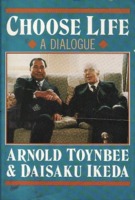
    Thanks to my friend Frantz Rimpel who gave me this book as a gift three years ago, I woke up this morning re-reading “Choose Life, A dialogue” between historian Arnold Toynbee and Buddhist lay organization leader Daisaku Ikeda. This book, published in 1972, is a record of Toynbee & Ikeda’s views on critical issues confronting humanity.

    toyn1The book is divided into 3 main Topics: 1.- Personal and Social Life (the basic human being, the environment, the intellect, health and welfare), 2.- Political and International Life (political system, one world, arms and war), 3.- Philosophical  and Religious Life (The nature of things, religion, good and evil).

    I read this book a couple of years ago. And this morning I rediscover the depth of its content. It’s always a pleasure to revisit and reread my books. I can go over my underlining and notes in the margin to agree once again with the author, and even disagree with myself.

    This is what happened in my skipping though the third chapter entitled : The intellect. It includes their thoughts and viewpoints on education, learning which are in my area of studies being part of a self-directed leadership education program called Life Leadership..

    Education helps the man to “see clearly what he ought to be and how he ought to live”, said Ikeda. And Toynbee to add that “education is a continuing search for an understanding of the meaning and the purpose of life and for discovering the right way to live. 

    “School education is insufficient to the full development and cultivation of individual abilities” Toynbee & Ikeda said, adding  that the kind of education system needed today is one that concentrates on developing the whole human being.

    Intellectuals and the masses

    “Learning today changes so rapidly that often what one learns in school becomes outdated and perhaps useless later on”, they said, arguing that people are more interdependent today and we need to get more involved in community activities to learn from varied life experiences.
    There should be no demarcation line between intellectuals and the masses. “Human beings are human beings before they are members of either the intellectual group or the masses”. But they also agree that “people need time and money in order to obtain the kind of education required for serious intellectual pursuits”.toynbee

    To become an intellectual, three things are required: 1.- Intellectual ability, 2.-The will to work hard at learning, and 3.- money.

    There should be “moral obligations” between an intellectual and his community. The intellectual owes it to society to perform a useful social service and society owes it to the intellectual to remunerate him sufficiently.

    This is what best selling author and founder of the Life Leadership Orrin Woodward called a compensated community. Life Leadership brings leadership education, life skills development to the masses . This lifetime educational system is targeting to reach in the upcoming year one million people globally reading, listening to audios, streaming videos, associating in open meetings, seminars, building and bonding in community learning groups. This is definitely the way toward bridging the gap bettween the intellectuals, content creators, innovators and the masses.

    Toynbee & Ikeda stated in their dialogue that “lifelong part-time education is the surest way of raising the intellectual and moral level of the masses”.

    Both intellectuals and the masses should come together, take our common humanity to set as a goal to promote FREEDOM from fear, JUSTICE for all, access to WEALTH for those who are ready to do the work.We must bring our uniqueness as human being, not as a class, group, tribe, in a concerted effort to improve humanity.

    God bless,

    #RooseveltJeanFrancois

  • Leadership Pope Francis: a plain conflict agaisnt the status quo in the Vatican

    Bestselling author Chris Brady defines leadership as a plain conflict against the status quo. This is  exactly what Pope Francis has been doing for the last three years. And he did it again last Monday of the Vatican bureaucracy.

    popefrancispopefrancis1CNBC reported Francis’ Christmas greeting to the cardinals, bishops and priests who run the Holy See was a sobering catalog of 15 sins of the Curia that Francis said he hoped would be atoned for and cured in the New Year.

    He had some zingers: How the “terrorism of gossip” can “kill the reputation of our colleagues and brothers in cold blood.” How cliques can “enslave their members and become a cancer that threatens the harmony of the body” and eventually kill it by “friendly fire.” About how those living hypocritical double lives are “typical of mediocre and progressive spiritual emptiness that no academic degree can fill.”

    “The Curia is called on to always improve itself and grow in communion, holiness and knowledge to fulfill its mission,” Francis said. “But even it, as any human body, can suffer from ailments, dysfunctions, illness.

    popefrancis2The annual Christmas greeting comes at a tense time for the Curia, the central administration of the Holy See which governs the 1.2-billion strong Catholic Church. Francis and his nine key cardinal advisers are drawing up plans to revamp the whole bureaucratic structure, merging offices to make them more efficient and responsive.

    The Vatican’s finances are also in the midst of an overhaul, with Francis’ finance czar, Cardinal George Pell, imposing new accounting and budget measures on traditionally independent congregations not used to having their books inspected.

    Francis, who is the first Latin American pope and never worked in the Italian-dominated Curia before he was elected, has not shied from complaining about the gossiping, careerism and bureaucratic power intrigues that afflict the Holy See. But as his reform agenda has gathered steam, he seemed even more emboldened to highlight what ails the institution.

    Francis started off his list with the “ailment of feeling immortal, immune or even indispensable.”Then one-by-one he went on: Being vain. Wanting to accumulate things. Having a “hardened heart.” Wooing superiors for personal gain. Having a “funereal face” and being too “rigid, tough and arrogant,” especially toward underlings — a possible reference to the recently relieved Swiss Guard commander said to have been too tough on his recruits for Francis’ tastes.

    CuriaSome critiques could have been seen as worthy of praise: working too hard and planning too much ahead. But even those traits came in for criticism as Francis noted that people who don’t take time off to be with family are overly stressed, and those who plan everything to a “T” don’t allow themselves to be surprised by the “freshness, fantasy and novelty” of the Holy Spirit.

    “How good it is for us to have a healthy sense of humor,” he said.

    At the end of the speech, Francis asked the prelates to pray that the “wounds of the sins that each one of us carries are healed” and that the Church and Curia itself are made healthy.

    Pope Francis is attacking the status quo with grace, and love. This is leadership.

    Read more on this report, tap on CNBC.

  • Launching a Leadership Revolution through Leadership Education & Critical Thinking

    Launching a Leadership Revolution through Leadership Education & Critical Thinking

    I am scheduled to give a presentation for 70 agents in an insurance company in Fort-Lauderdale, Florida, which is one of my customers for the LLR Corporate Education System. My keynote speech will be based on the New York Times bestselling book Launching a Leadership Revolution co-authored by two of the top 25 global leadership gurus Chris Brady and Orrin Woodward.
    makethumbnail.ashx“Our LLR System is designed to gradually and effectively transform your existing professional-level talent into engaged, contributed, go-to leaders”, I told the managers of this firm in a conversation referencing to a flyer of the Life Leadership Company which I represent to market its suites of leadership and self-education materials.
    How to develop engaged employees in the workforce? How can every member of this firm can use their brain to think critically about issues and problems that this company is facing? How to develop a culture of self-directed education and critical thinking in which each member of this team can dig dip in their mind to come up with thoughts that will move the company ahead?
    Those are the questions I will be addressing with my audience challenging them to create an atmosphere and an environment that encourages inquiry, exploration, discussion and debate. Those who decide to be up to this challenge will be part of a community learning group (10-12 employees) through a pilot program for the upcoming 6 months. Each employee will have access to a book and 4 audios a month and I will facilitate a discussion with them on topics such as values, vision, professionalism, self-confidence, conflict resolution etc…

    The six monthly packages of 1 leadership book and 4 audios each provide just the right amount of new information and principles every month over an extended period of time in order to foster lasting change in employees and systemically transform the workplace environment into a culture of leadership. We also created optional tests that are available at no additional charge so employers can monitor the progress of individuals while encouraging employee participation and group discussion.
    deweyThe reward and the return of this investment is to see employees to come to work better prepared. They have to ask themselves “how can I apply what I read, what I listened, what I discussed in my work today”, “how can I apply this to my home, my family, and my community”.
    I will complete this post with philosopher John Dewey who asserted that education and learning are social and interactive processes. He believed that human beings thrive in an environment where they are allowed to experience and interact with each other in a constructive way.
    I will develop more on Dewey’s Critical Thinking on my next post.

    God bless,

    Roosevelt